Geppetto

Let agents work.
Keep people in control.

An agent is software carrying out an assigned task. Geppetto is designed to coordinate those tasks and keep required approvals with the people responsible.

Explore a checkpoint

Specified architecture · Implementation and validation are development work.

Start a caseHuman, system, or event
Assign the workEngine checks permitted tasks
Read documentAgent A · Proposed findings
Check a ruleSystem B · Proposed result
Review findingsAgent C · Proposed changes
Bring the work togetherCombine and check the permitted results
Required approvalApprove · redo · escalate
Save the approved resultSaved in one step · Result + decision together
Illustrative target workflow · Three tasks run in parallel. The engine records authorised changes; agents cannot rewrite the authority they receive.
Parallel work and human decisions

An approval changes the next step.

If a document changes, a later approval may need to be reconsidered. A redo keeps the earlier attempt in the history instead of overwriting it.

TWO TASKS RUN IN PARALLEL · BOTH STAY UNDER CONTROL StartInitial case state Agent / tool branch AOwn attempt, own record Human / agent branch BOwn attempt, own record Approved AVersion recorded Approved BVersion recorded Governed joinEvidence + permission A challenged earlier result can invalidate dependent approvalsOriginal entries remain; affected branches are rerun under an authorised decision.
StartInitial case state
Agent / tool AOwn attempt, own record
Human / agent BOwn attempt, own record
Approved AVersion recorded
Approved BVersion recorded
Governed joinEvidence + permission
A challenged earlier result can invalidate dependent approvals. The history is retained for reconsideration.
Explore a checkpoint

One decision, five controlled outcomes

Choose an authorised review result to see how the next action changes. This demonstration does not execute a customer workflow.
Approve · Commit and proceedThe authorised approval is recorded. Only eligible approved state changes are admitted; the next dependent step may begin.

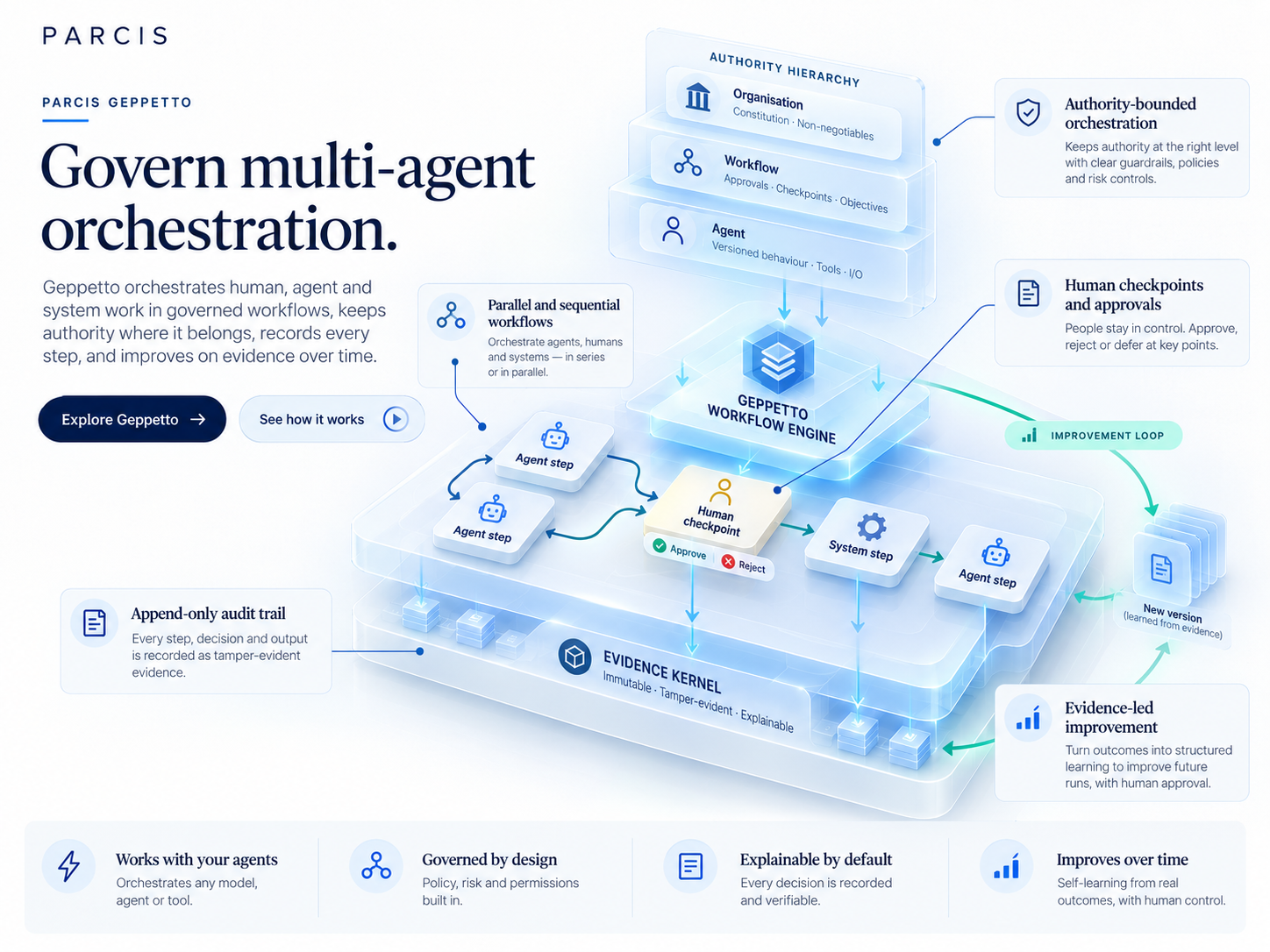
Authority comes from the organisation.

Your organisation sets the rules. Each workflow and agent receives only the authority needed for its task. The engine checks that authority before assigning the work.

Geppetto orchestration architecture: organisation, workflow, and agent authority govern the workflow engine, agent and system steps, human checkpoints, the evidence kernel, and an approved improvement cycle.
How Geppetto works

Six stages. One execution history.

Follow one run from its starting request to the approved result. A task proposes a change; the engine decides whether that change is authorised to enter the record.
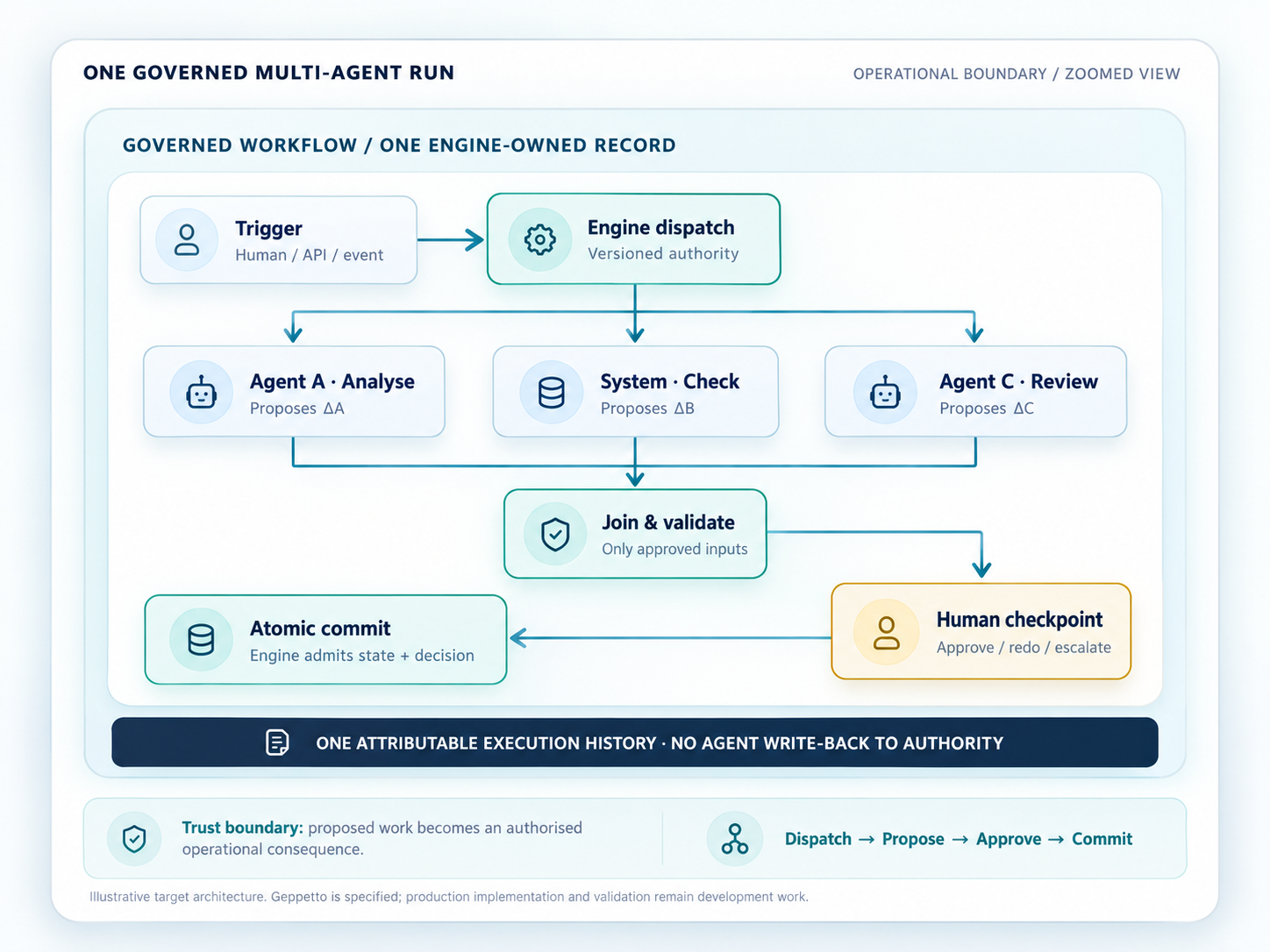
One governed multi-agent run: a trigger and engine dispatch lead to three parallel agent and system steps; proposals join for validation, pass a human checkpoint, and are committed to one attributable execution history.
Governed improvement loop

Improve the process. Keep changes governed.

The recorded outcomes can suggest ways to improve the process. An authorised person accepts, changes, or rejects each proposal. Approved changes apply to future work.

1 · Run

Record outcomes

Track each attempt, approval, decision and result across the workflow.

2 · Analyse

Measure

Look for patterns, differences and recurring problems in the outcomes.

3 · Suggest

Propose

Suggest improvements. Each cites its evidence and can be reviewed part by part.

4 · Human approval

Decide

Accept, modify or reject each element under recorded authority.

5 · New version

Track and retain

Measure impact, retain lessons and inform later workflows.

↺ Next governed runApproved versions inform future work. Rejected proposals stay in the record; nothing is adjusted out of sight.

Validate one governed workflow.

Agree the participants, permissions, checkpoint and evidence outputs for a bounded use case. Explainability Layer test results do not establish Geppetto’s performance or enterprise readiness.

Develop a capability with us