Explainability Layer
Record AI decisions.
Show the evidence.
When an AI tool checks a document, what did it use, which rules ran, and what was released? PARCIS captures a record that your team can examine later.
Explore a receiptDefined capture and verification mechanisms demonstrated in controlled tests.
- What ran
- Document-check tool
- Rule used
- Policy P-118
- Control outcome
- Release allowed
One record. The view each reviewer needs.
A customer questions a document check. Operations, audit, the regulator, and the customer can each receive the evidence they are permitted to see from the same captured interaction.
This sample receipt uses fictional data.
Fictional document-check record
An integrity check tests whether the record matches what was sealed. It does not prove that the original information was true.
From a request to a recorded outcome.
The configured process connects the request, release rules, captured evidence and resulting action.
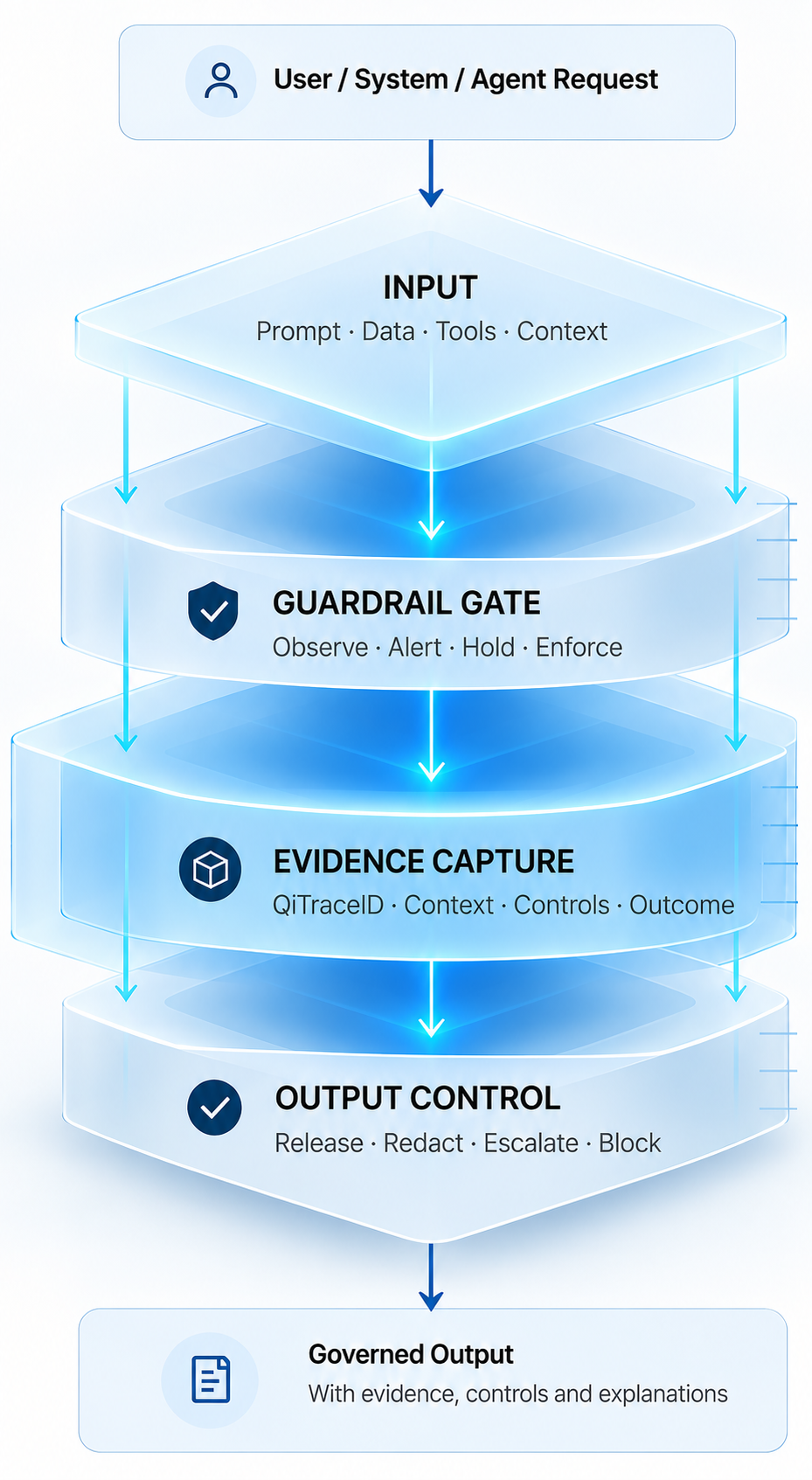
Capture coverage, guardrail actions and available exports depend on deployment configuration and authorised access.
Choose the depth before capture.
Different processes need different amounts of retained detail. You choose the depth before the decision is made; it cannot be added afterwards.
A receipt
Derived evidence and governance records, without needing to retain the full underlying conversation.
- A linked record of the decision
- Which policy and release check applied
- Minimum necessary evidence
Retained interaction detail
Tier 1 · Documentary replay
Retain the configured evidence needed to reconstruct the recorded interaction and support deeper review.
- Everything in Tier 0
- Replay of the recorded interaction, within set limits
- Protected storage of the content, where configured
Additional investigation detail
Tier 2 · Scoped forensics
Richer investigation artefacts for authorised, time-bounded incident windows.
- Additional captured forensic detail
- Switched on explicitly, with a stated reason and retention period
- Incident-specific evidence analysis
What the controlled tests established.
The controlled October 2026 exercise produced 178 sealed records, 43 groups of related events (traces), 23 AI interactions and 20 recorded process observations. All unchanged records passed verification against the specified keys.
Of 17 adversarial cases, 12 manipulations were detected, four documented limits remained, and one case was an unchanged control. This is evidence from controlled testing, rather than independent certification or an enterprise performance benchmark.
Cryptographic checks establish integrity against the relevant keys. They cannot establish that source statements were true, or that events outside the captured process occurred.
Test one process in your environment.
Agree the interactions to capture, the release rules to check and what your reviewers need to verify. Evidence outside that capture boundary remains outside the claim.
Plan an evaluation